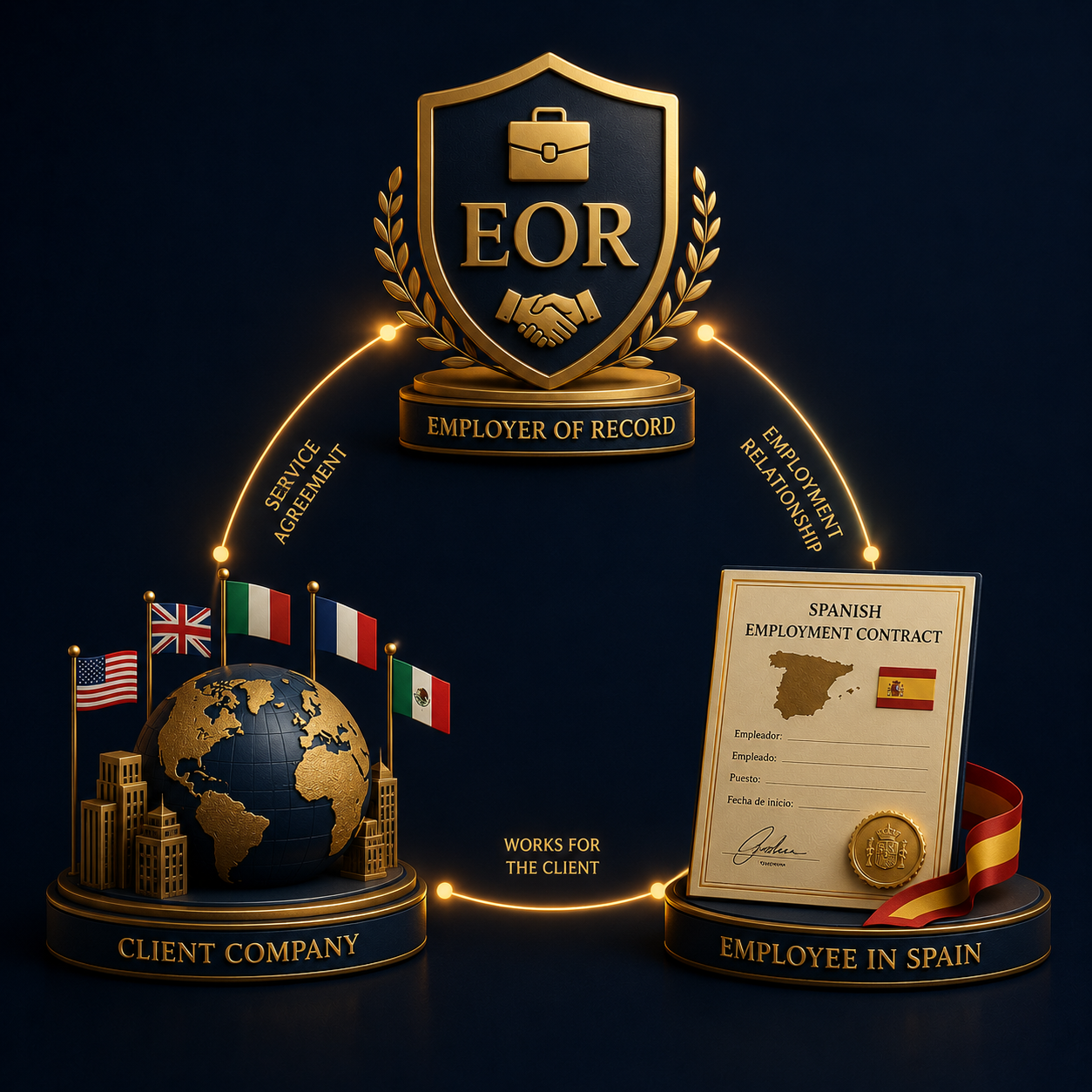
1 - What Is Employer of Record in Spain?
An Employer of Record (EOR) allows a foreign company to hire or relocate talent in Spain without immediately setting up a Spanish legal entity. The EOR or employment partner acts as the legal employer on paper — handling employment contracts, payroll processing, social security registration, tax withholding and local HR compliance — while the client company retains full day-to-day management of the employee's work.
In Spain, EOR arrangements require careful assessment. Spanish employment law is highly protective of workers, and the relationship between the staffing company, the client company and the employee must be structured correctly to avoid legal liability under illegal labour leasing regulations (cesión ilegal de trabajadores).
EOR is not always the right solution — and in some cases, an umbrella arrangement, contractor structure, autónomo setup, or Spanish subsidiary is more appropriate. The decision depends on the role, salary, duration, visa requirements and long-term hiring plans.
2 - When Is EOR the Right Choice?
EOR is most useful in specific situations: when a foreign company wants to hire its first employee in Spain and is not yet ready to commit to a Spanish legal entity; when a company needs to relocate an existing employee to Spain quickly while maintaining local employment compliance; when testing the Spanish market before establishing a permanent structure; or when onboarding senior talent who requires a local employment contract and full Spanish social security coverage.
It can also help international companies compare different structures before committing to a Spanish subsidiary — especially when headcount is small, the business model is still being validated, or the long-term presence in Spain is uncertain.
EOR is generally less suitable for very senior roles with significant management responsibilities, roles where the worker will direct or supervise Spanish staff, or structures where the commercial and operational presence in Spain is substantial enough to create permanent establishment risk regardless of the employment arrangement.
3 - Key Risks & Compliance Points
Spain is one of the most protective employment jurisdictions in Europe. EOR arrangements in Spain must carefully address several legal and compliance risks.
Illegal labour leasing risk. Spanish law prohibits arrangements where a staffing company merely loans workers to a client without genuinely acting as the employer. If the EOR is not genuinely managing employment obligations and the client company exercises full employer-level control, the arrangement may be classified as illegal labour leasing — exposing both parties to significant penalties.
Collective agreements (convenios colectivos). Most employment relationships in Spain are governed by industry-wide collective agreements that set minimum salary levels, working hours, benefits, notice periods and termination entitlements. The applicable agreement depends on the employee's role and sector, not the EOR provider's classification.
Social security and payroll costs. Spanish employer social security contributions total approximately 30–32% of gross salary in 2026, including common contingencies (23.60%), unemployment (5.50% for indefinite contracts), FOGASA (0.20%), professional training (0.60%), the MEI intergenerational equity mechanism (0.75% in 2026, rising to 1.2% by 2029), plus a variable rate for occupational accidents. This is one of the highest employer cost burdens in Europe and must be factored into total employment cost comparisons.
Permanent establishment risk. Depending on the employee's role and level of authority, their activities in Spain may create a taxable permanent establishment for the foreign parent company — regardless of the EOR structure. This risk must be assessed separately.
ApexTax provides informational guidance only. Formal employment, tax and immigration advice must be provided by qualified professionals.
4 - EOR vs Umbrella vs Autónomo vs Spanish Entity
When assessing the right employment structure for Spain, four main options should be compared:
EOR (Employer of Record). Third-party company acts as legal employer. Fast to set up, no Spanish entity required. Higher cost per employee, legal leasing risk if not structured correctly. Best for 1–3 employees, short-to-medium term, or market testing.
Umbrella company. The worker contracts with an umbrella provider, which handles invoicing, payroll and compliance. Common for contractors and freelancers. Not suitable for employment relationships with strong employer control.
Autónomo (self-employed). The worker registers as self-employed in Spain. Lower employer costs, but creates worker misclassification risk if the relationship is genuinely employment. Not appropriate for exclusive or near-exclusive client relationships.
Spanish entity (SL or branch). The company sets up a Spanish subsidiary or branch and employs directly. Higher setup cost and administrative burden. Best for long-term, multi-employee or high-risk permanent establishment situations.
The right structure depends on worker profile, role, duration, income level, visa situation and the company's long-term Spain strategy.
5 - How ApexTax Helps
ApexTax starts with a structured assessment of the company's situation — worker profile, role, salary, visa status, expected duration, management structure and operating model — to give a preliminary picture of which employment structure best fits the specific case.
We help the company understand EOR versus alternatives, the compliance risks of each option, the social security and payroll cost implications, the permanent establishment considerations, and the practical steps for whichever route is chosen.
Where formal employment law advice, EOR provider selection, immigration support or tax structuring is needed, we connect clients with trusted employment lawyers, EOR providers, payroll specialists and immigration advisors from our verified partner network.